Beekeepers Friend

Peaches' Beekeeping Blog

June 24, 2007

Swarm Work

About a month ago, I had a swarm move from one of my nucs to a brood box that was on the top of a stack of brood boxes to be cleaned. I was surprised that they picked that one. The box was a mess and I had intended to clean it and put a new bottom board under it.

I looked at it today and the bees were hanging under the bottom of the landing area as well as on the face and side. I would guess that there were about 4-6 lbs of bees. I am getting ready go to Texas for a family reunion and the bees will swarm before I get back. Now I will have to put them in another box with a good bottom board before I go. In case you haven’t experienced that yet, I will tell how I do it.

First get a box and, using the big staples, nail the box on both sides near the 4 corners by placing the staples on one side in opposing directions. That will help keep the bottom snug against the bottom of the brood box. Do the same on the opposite side.

Then take the frames out of the old box, one at a time, being careful to pull straight up. Don’t want to roll the bees and take a chance on killing the queen. Place each frame as you pull it, into the new box in the same position as it was originally. Moving the bees stresses them, so you want to keep the stress level down as much as possible.

Once you get all the frames moved, place a honey super with frames and foundation or drawn comb on top of the brood box. Normally, you place the brood box in the same place that you removed the old one from. In this case, I will have to move the hive to another location as I need to be able to get to the stack to clean it.

I will place the new hive in a place that I can leave them alone for a while. I will take one of the frames that has brood and put it in a nuc and place the nuc in the same place as the old hive and let the field bees come home to the only place they know to come back to. By using a frame of brood, the bees will accept the temporary box as home because the babies need to be fed. Using this same principal, you can hive a wild swarm much easier and they will accept the box much more readily.

At night when all the bees are back home, I will take the nuc and place it on the hive that I moved the main colony to. The next morning, I will take the frame of brood and put it with the other frames in the new box and shake the bees into the box on top of the frames. That way the majority of the bees will have to leave the parent hive to reorient themselves to the new location. When moving bees like this, it is better to move them at least 3 miles away from the old location. Otherwise, they will just fly back to the old location (stack of boxes in my case) and mill around looking for home. After about 3 weeks they will have forgotten the old location and will be oriented to the new home. If you want them in the original yard, you can bring them back at that time.

Some beekeepers, hobbyists mostly and some small sideliners, will change boxes on a regular basis each year, so they can repair, replace, and paint the boxes to reuse somewhere else. (Just to keep their equipment looking pretty.)

June 19, 2007

You Ever Have One Of Those Days…??

Monday, I got a call from Commander (Cmdr) Porter (Retired), where one of my hives is residing. He was very concerned that the bees were not coming and going like they used to. “OK,” says I, “I’ll get over there about 2 in the afternoon.”

I finished my work at the house and got my equipment (hand truck) in the Ram. I keep a smoker and hive tools in there all the time, never knowing when I would need them. I got into the truck and turned the key. Nothing happened. Dead battery! Rats! All my neighbors were gone from home. If I had a standard transmission, I could use the hill that my driveway sits on and jump start the truck before it reached the street. However, I have an automatic. Double Rats! I would have to wait for my wife to come home from work to use the jumper cables. She had to work late.

When she got home, it was raining. OK, I will call the Cmdr and tell him I will be late. The phone number is not in my desktop so I grab a phone book and open the white pages. I then get my reading glasses and look for his number. Not there. He must have an unlisted number. Rain stopped. I go out and get the truck jumped off. By now it is dark.

This morning I had some things I had to do before I got started on the outside stuff and I was late getting to the Cmdr’s house. I looked in the phone book again and that was when I found that, last night I had gotten an Alabama phone book instead of my local Florida book. It was nearly 12 noon when I got there and caught him before he sat down to eat. He likes to watch me when I work the bees. Since I had not seen these bees in about 5 months, I was not surprised to smell the hive as I was walking up to it. It did not smell like American Foul Brood (AFB), which, to me, is a strong putrid scent, but it did have a strong odor and I suspected that the Small Hive Beetle (SHB) had taken over. I was right.

The top honey super still had lots of honey as well as the lower honey super. There were lots and lots of beetle larva crawling all over the frames. The tops of the frames were wet which would not be if the bees were still there to keep the humidity down. I had to go back to the truck to get the hand truck. I just got the hive (bottom board, brood box, and 2 honey supers) loaded and started back to the truck when the rain started in earnest. I got to the truck and parked the hive on the ground and ran to the covered porch. We had just started talking and drinking our tea when the rain stopped. I got thoroughly wet and got under cover and the rain stopped. I think that today was not a good day for me.

With the help of the Cmdr, by using a 2 man hive lifter, the hive was loaded intact in the bed of the Dodge Ram and strapped down. He gave me a quart of homemade pickled beets and a quart of homemade sauerkraut before I could say my good byes and leave. I got home without any problems, but when I got out of the truck and before I could get to my front porch, I was drenched again. Needless to say, the hive boxes are still in the pickup bed and will stay there until I know for sure that the rain has stopped.

I hope your day has gone better than mine.

June 16, 2007

Texas Visitors Gone

My Texas In-Laws’ visit has come to a close. They left this morning about 8:00. My niece’s boyfriend had never left Texas before going with her family to Branson, MO this time last year. When they invited him to come to Florida to stay with my wife and me, he jumped at the opportunity.

They arrived Sunday and stayed all week. We fed the family at Lambert’s Restaurant Foley, AL where they throw the rolls across the room to the diners. Brandon, the boyfriend, couldn’t believe that they did stuff like that. Then we took them on a ferry ride to Dolphin Island just south of Mobile, AL. Brandon couldn’t hardly contain himself.

On the way back, my Brother-In-Law and the youngsters stopped at the U.S.S. Alabama while my wife, Mother-In-Law, and I came on home and had a good visit.

Here I need to point out that none of this has anything to do with beekeeping. BUT —- a little background to my frame of mind. Since Nov., I have had 2 eye cataract surgeries, a knee surgery, went to the Emergency Room with suspected heart attack, and I have been on weight restriction (5# lifting max and staying off my knee with only PT movements) until just 2 weeks ago. I was so far behind on my bee work and home work that I had to choose to work on the home front getting ready for my Texas relatives’ visit. All the time I was entertaining, I was thinking of what I needed to do when I got back in gear. I found out that while I was convalescing, I was getting weaker and weaker and when I did start to work this afternoon (I went to our Beekeepers Association meeting from 10 until noon), I found out that I gave out rather quickly. I have to get into working the bees and equipment gradually.

Anyway, I was supposed to go canoeing at Adventures Unlimited with the family, leaving my wife and her mother to run around on their own. I found out that the young lady I had promised to take canoeing for her graduation present, had to work. So I spent the day on the computer with my son to get this site set up.

Needless to say, there were trips to the zoo, Florida’s Gulfarium, Beaches, and swimming every evening in our pool in the back yard. All in all, we had fun this week and they were already discussing their trip next year. Maybe at that time I will have gotten my boxes cleaned and ready to go to the bee yards. With Brandon as a willing helper, I can get my bees into cleaned and painted boxes, and give him a chance to get his feet wet enough to start a hive or two of his own.

I have bored you long enough with trivia, now my next post will be about bee stuff. Come back and visit again.

June 14, 2007

Visitors

I have had visitors from Texas all week and I have not had time to go to the apiaries. I don’t know what my bees are doing at this time. Need to make enough screened bottom boards so they can replace the solid ones. I hear good things about the colonies that have the screens. They seem to be stronger and more healthy. I have some screened bottom boards on the new swarms that I hived and I like the way they are growing.

I have some brood boxes that need to be replaced, so I am in the process of cleaning (scraping the wax and trash out of the boxes) some more boxes and will probably spend a day changing them out. While I am there, that would be a good time to pull honey for extracting. Taking some empty supers then would be smart too so the bees would still have room to work without deciding to swarm. Normally at this time I would have extracted two times getting ready for my final extraction in October. I leave one super of honey on each colony for winter feed.

There are two thoughts on over wintering. [1] Honey is paying bulk rate of around .80 a pound and you can feed corn syrup for .14 a pound. But since we don’t know what is causing the Colony Collapse Disorder (CCD), I feel that maybe the corn syrup (type and amount of Fructose) might have something to do with it. [2] Nature intended for the bees to eat the honey they have processed. That is why the first super of honey they produce should be left. Anyway, that is my reasoning.

Soon, I should be able to tell you plans for building screen bottom boards, changing out the brood boxes, starting the extraction process, and maybe cleaning the apiary grounds, getting ready for winter. However we still have the cotton and some fall honey flows here in NW Florida before I completely shut down for the winter.

Since Blogging is still new to me, maybe my writer son, who is a Missionary to the Deaf in Mérida, Yúcatan, México, www.missionarytalks.com will give me some pointers so you, the reader, won’t get bored. Have a Good Day.

June 13, 2007

Beekeeping Seminars

The Tupelo Association will host a beekeeping seminar on 14 July at  Laurence Cutts’ honey house 1533 Clayton Rd., off Hwy 77 in Chipley, FL; registration deadline is July 6. A full day is in store including smoker-lighting contests and open-hive demonstrations.  For details, see http://floridabeekeepers.org.

June 12, 2007

Trip to Yucatan 2005

This photo is from my trip to Mérida, Yucatán (México). My loving son took me to the agricultural campus of the state university (UADY). They have an extensive beekeeping department at the school.

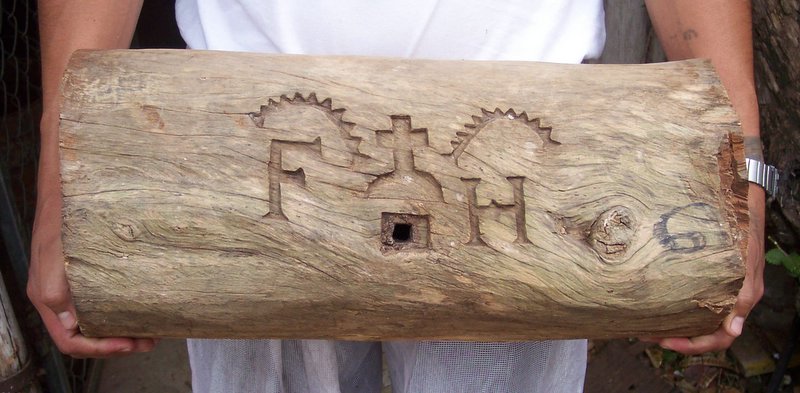
This picture is the hive of a type of stingless bee, of which they have many. The little hole in the front is where the bees fly in and out. The log is hollow. On the end there are removable caps so that the beekeeper can open the end and poke the pods of honey so that it drains out. This type of bee does not produce a lot of honey, but what is produced carries a valuable price. The example the beekeeping instructor gave was that normal honey sells for about $3 per kilo there in México. But this honey can sell for more than $30 per kilo.

Stingless bee hive

The reason for the large beekeeping program is that honey is the largest agricultural product in the Yucatán today.