Beekeepers Friend

Peaches' Beekeeping Blog

March 15, 2009

Spring Is Here

Here in Northwest Florida, the Spring honey flow is in full swing. You should have all your hives covered with 2+ honey supers. If you are making comb honey, then you should have those supers on and monitoring them closely.

I personally have not gotten into the Spring Swing because my wife has spent from Dec 21st to Mar 3rd in the hospital and I was staying with her except to come home and sleep, bathe, and put on clean clothes. Since we have been home, I have been her sole caregiver, except for Home Health Care and PT 3 times a week. I have not been able to work on cleaning boxes, frames, and installing foundation. I hope to be able to start soon, but in the meantime, I will try to keep this blog up to date.

Thank you for your inquires as to why the website is lacking in posts. Now you know. As Kim Floatum, editor of the American Bee Journal, says, “Keep your smoker lit and your hive tool sharp.” Until the next time.

February 11, 2009

Steps to Beeing Successful

I have compiled a few notes to help you to be a more successful beekeeper. I also needed this information for myself. Here goes——

1. Plan: Long Range Goals. Think about what you want to accomplish with your bees. What are your goals? Do you want to keep bees for just the enjoyment of watching them as they work? Do you want to sell honey? Do you want to sell bees as nuclei to other beekeepers and/or new novices? Do you want to pollinate with your bees?

2. How would you go about accomplishing this? You need equipment such as wooden ware for new boxes, both brood and honey supers. You need to have frames for all of your boxes and that means foundation. Do you want to use wax coated plastic foundation, or real wax? If plastic, then do you want to use plastic frames or inserts? If real wax, then you need to have wires either in the foundation or you need to wire the frames and embed the wires either with an electric embedder or manual embedder for strength. Are you going to make comb honey, then you need a smaller super and comb honey foundation which is thinner than regular foundation for extracted honey. Or would you like to use ?

3. Are you going to use the wax cappings for candles, lip balm, and/or soap, or are you just going to melt all the extra wax for sale or trade to the supply houses? Then, my friend, you will have to have equipment for those things.

4. Pollination is a horse of different colors. You need to have a way to transport lots of hives to the target fields and have equipment to feed the bees for 6 weeks or so. This will be discussed at a different time in a different post.

7. Making honey for sale needs to be thought through also. You need an extractor of some kind and buckets to transfer honey to the bottling tank. Then you need jars such as pints quarts, half gallons, and gallon jars. Do you want to use glass or plastic? Is this honey all going to be for sale or are you going to give some for gifts for the various seasons? How are you going to present, wrap, or display it?

8. If you want to make bees for sale, then you really need nuc boxes. Sometimes you will sale just the bees on frames with frame exchange. You need ideally, new frames in your makeup hives so they will be nearly new to your customers and that way when you receive their new frames, they will not be getting a bad deal. Also, nucs would be good to have in your own bee yard (apiary) to help some of your own weak hives. Sometimes you will sell the whole thing, box, bees, top, and bottom boards. (This will be at a higher price than just the bees.)

9. Short range goals. How many colonies do you need or want? Where will you keep them. Do you have some contacts that will let you place your hives on their land? Can you get to them 24/7? These are some of the things you have to take into consideration now before you even try to get started. If you have a back yard or some land then you can get started right away.

10. Now is the time to think of the economics. How much money can you devote to your bees right now? As you progress, the sales of bees and honey will bring you more dollars for expansion in the future. How much time do you have to give to your bees? Time is a factor for how many hives you can economically handle by yourself. Fuel is a very important consideration. With the price of fuel today, you need to have the locations for you apiaries as close as feasibly possible. Again, equipment plays a big part in your plans. Truck/pickup and/or trailer is part of the equipment you need.

11. Joining an association (local as well as state) is an excellent way of gaining information. Then there are books, books, books, magazines, internet, and workshops. These are tools for information for planning and doing.

These steps are not meant to discourage you, but to inform you how to go about raising bees for enjoyment and profit without bankrupting your finances or marriage. Don’t think of keeping bees as a hobby. Hobbies are what you spend money on and get nothing back but enjoyment. Think of this as a lemonade stand. You have to spend some money to get started, but once you get your lemonade made, you can get money for your efforts above and beyond your costs. Now you can start expanding by setting up more lemonade stands in other neighborhoods to get even more money, even if you have to pay someone to help/work for you. This is called free enterprise.

See you at the Chautauqua!
February 2, 2009

Attend the Chautauqua

The North Escambia Bee Association (NEBA) invites every one to our Chautauqua at the Northview High School located on FL State 4 just east of Bratt, FL. Lots of information, visiting, honey and bee gadgets will be judged if any of you bring something to the judges to be judged. Go to the link to get the information.

There will be auditorium classes, and also beginning and advanced classes. Snacks and drinks will be offered. Door prizes will be given several times during the day. We will have a trading post where you can shop, trade, sell, buy, or give away extra or unwanted equipment. There will be advanced beekeepers to talk to one on one.

We will be looking for you. Drive carefully!

January 30, 2009

Judging Honey Shows

General Rules for the Chautauqua Judging of Bee Related Items:

  • Anyone may enter.
  • The judge(s) reserves the right to limit the number of entries on a first-come, first-admitted basis.
  • There are twelve show classes:
    • Extracted honey: Light
    • Extracted honey: Amber
    • Extracted honey: Dark
    • Chunk honey (honey in comb in jar with liquid honey)
    • Black jar (honey in a black jar)
    • Cut-comb (honey in comb in plastic container)
    • Creamed honey
    • Beeswax cake (a single molded piece of two pounds or more)
    • Candle (poured or dipped, straight or ornamental)
    • Original bee-related photography
    • Original bee related art
    • Beekeeping gadgets
    • NEW CLASS- Gift packs. (All items must be named as to what it is and what kind it is. example: Salt and Pepper Honey – Wildflower, and Tupelo; or Bees wax candle – hand wrapped or molded, and colored)
  • Contestants may enter in any or all classes, but may enter only once per class.
  • The same honey cannot be entered in both the black jar class and another extracted honey class.
  • All  entries must have been produced by the submitter and within the last 12 months.
    • This 12 month restriction does not apply to entries in photography, art, gadgets, or gift packs
  • All entries for honey and candles must be submitted in triplicate: i.e., three matching jars of honey, three boxes of cut-comb, or three candles of same type (poured or ornamental).
  • Black jar entry is a single (one) glass jar to be provided by judge(s).
  • Submit extracted honey in standard mason pint glass jars (smooth or embossed as long as three same kind).
  • Submit chunk honey in standard mason pint wide mouth glass jars. Insert only one piece of comb in each jar.
  • The sole criterion in the black jar class is flavor.
  • Your one jar entry will be placed on shelf by staff.
  • Beeswax must be pure beeswax.
  • Art and photography must be presented in a self-standing frame, and each accompanied with a 3 x 5 card giving the title and brief “story” behind the piece.
  • Do not label any of the products in any way: an identifying code sticker will be assigned to your entry at registration.
  • All entries must be submitted by 10:20 am Saturday, February 21st, 2009.
  • Judging criteria are selected at the discretion of the Judge(s), and decision of Judge(s) is final.

All entries are to be turned into the Honey show registrar, who will tag and place the entrants in the correct categories.

January 13, 2009

Confession Time

As you know, this blog is about bees: Teaching, learning, doing, reading, and thinking bees. I told you once before that I started this to tell what I do with my bees. At this point I must say, “Do as I say and not as I do!”.

There are various reasons that I have not seen my bees for almost 6 weeks. This is the time that I need to be attentive to their winter feed stores. I really do not know if I still have any bees left in my hives. The last time I was in the bee yards was to check the new queens. All 12 colonies and 7 splits were doing very well. I left them for for a week and went to Orlando, FL for a week to my youngest son’s pinning for completing his RN school. When we came home, my wife went to the emergency room with excruciating pain and ended up in the hospital for 23 days with Pancreatitus. Now I cannot leave her by herself for too long at a time as she is still very weak and I have to give her 4-6 small meals a day, also there are followup Drs.’ appointments that have to be done in the next two weeks.

Most of the beekeepers that I could have asked to check them works a job and works with their bees on the weekend. The others are in my category and are not physically able to take on another group of bees. So I just have to trust that I will have bees when I can break loose to go to the apiaries.

Needless to say that I have to have faith and hope for the best. Beekeeping is not an exact science, but there are some things that needs to be done in a timely manner. You will have times that nothing seems to go right and no matter what you do, you cannot change it. That is when you just have to suck it up and do what you can when you can. I know that the bees have been around for a long time and they didn’t need my help then,  so maybe they don’t need me now.

But not all is lost. I have been reading and studying and making plans for the time that I will be able to go to the field. If you are going to use screen bottom boards, have you got them ready? If you know that you need to change brood boxes, have you got the right number and are they ready? Is your honey supers clean and do you have foundation in all your frames ? Have you marked your boxes yet? Do you have enough supers to put an extra one on each hive? If not–when are you going to get it done? Oh! and by the way, do you have enough 5 gal buckets to put your honey in once you start extracting? These are questions you and I should be asking ourselves. Only you can answer that. I am not ready in any of these areas. I have been busy trying to get out of doing these things. Now I wish I had someone to tell me to get busy. It is hard to work for myself. If I was paying me, I would have fired me before now. Good help is hard to find.

Get ready— because the Spring honey flow is commencing!

January 11, 2009

Spring Has Sprung

Do you realize that the Bee Spring is here? Just think, the bees are laying frantically to have the full force of bees for the Red Maple and other early bloomers. That is — the queen is laying frantically, if —- she has the pollen and nectar available. Now is the time to check the hives to make sure that the bees have any food left since they just went through Winter. Believe it or not, THIS IS THE TIME THAT MOST BEES STARVE TO DEATH! And they can starve to death with just one of these two elements missing.

I would rather you have to check the hives in the rain or snow than to have you lose your colonies for the lack of something as simple as maybe a pollen patty or a little sugar water. The easiest way to check a hive is to lift the back of the hive to gage the weight. If it is heavy, then you have enough honey, but if it is kinda light, then you need to go into the hive to visually check for honey and while in there check the pollen cells. You need at least a 3/4 frame of pollen. Usually if you have enough honey then the pollen is okay, BUT, you need to check your pollen at some time to be sure.

There should be eggs galore in the cells. If not, then look for a reason. Check pollen. That is the most important food of the larvae. However, the honey at this time is also important, as it is used to keep the colony warm. I hope that you get the idea that both pollen and honey is most essential to the coming-out-of-winter. If your truck is running on fumes and you still have to go a mile to the gas station, then you may or may not make it to the fuel pump. The bees have to have enough honey for the flight to the pollen and nectar stations.

Hope you have your equipment ready. It would be a good time to make sure that the empty boxes are painted so you can exchange brood boxes. Then you can clean and repair the ones that you exchanged for at your leasure.

Good luck this new year. I wish you a profitable year of pollination and honey production.

December 1, 2008

4-H Field Harvest Days

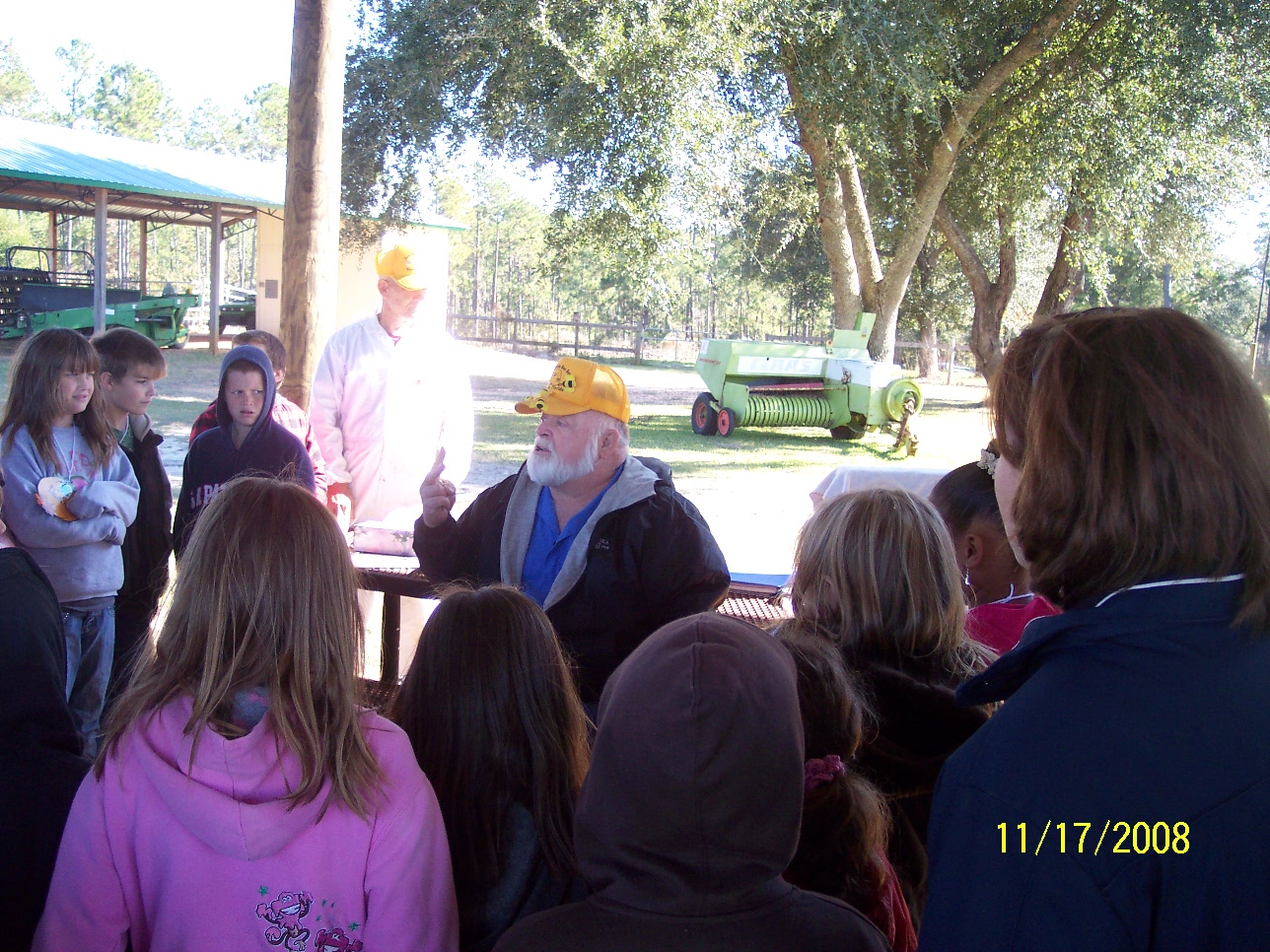
On November 18, I participated in the 4-H field trip for 2nd and 3rd graders from the area school district. The children were introduced to the farming industry consisting of cows, agriculture, and of course honey bees for pollination. It was a fun day. We, the instructors, told the youngsters about the livestock and their products.

All about bees and pollinationCows: meat, milk, cheese, butter, leather for clothing; Agriculture: planting seeds for food, fruit and vegetables, and hay for cows, horses, and wildlife; Honey Bees: honey, pollination for fruit, vegetables, and plants for livestock and wildlife, flowers, nectar and pollen, uses of honey, propolis, wax, and bee stings for medicine.

The staff had some fruits for the young ones to snack on. This helps to reinforce what we told them. They also had some coloring booklets to take home in hopes that their parents would ask questions about what they learned.

We had approximately 200 children attend with their teachers. If you get a chance, that is a good place to start to get used to presenting your knowledge to others. You could be an ambassistor for the honeybee.

November 29, 2008

No Bees in Honey Supers

The one thing that you really don’t want in your extraction room is bees. They can sting unsuspecting fingers and other exposed parts of the body.

The place to get rid of the bees is at the hive location. Now there are several ways to do this, however, keep in mind that there is no right or wrong way to rid the honey supers of bees. I will tell you of several ways to do this and then my preferred way.

Using a bee escape below the honey super will take a day. If you have multiple honey supers on the hive, it will take even more time. You have noticed that rectangle hole with each end of the rectangle rounded on the inner cover. That is where you place the bee escape insert. The inner cover is then placed between the super(s) and the brood box with the escape on the underside of the inner cover. This will allow the bees in the upper super(s) to leave and will not let any bees back in. When you remove the honey super(s), remove the insert and place the inner cover on top of the new empty super and replace the top telescope cover. That is, if you use the telescope cover. If not, then do not put the inner cover on the hive.

The next way to rid the bees is to remove the super to a location away from the hive and truck, and using a bee brush, brush the bees from each frame and place the frames in the truck. This is a time consuming job, but is still quicker than using the escape system.

You can use a fume-board and some Bee Go, Bee Robber, or Fischer’s Bee Quick. The first two are very odorous and really stink up the truck if you get some on you or your hands. Fischer’s Bee Quick is not odorous at all to humans, but it will do the same job as the other two. (When working the bee boxes and not picking up the queen, I sometimes put some Fischer’s Bee Quick on my exposed hands to keep the bees from stinging me. It does work, but like anything else, too much will cause the bees to attack.)

The last way to rid the supers of bees is by using a leaf blower. I have one that creates a wind velocity of 200+ mph. This is my preferred way to harvest the honey supers. Stand the super on end and blow through the frames moving the bees out the other side toward the front of the hive.Bee Blower Sometimes you may need to turn the super around and blow the other way to get all the bees out. This will encourage the bees to go into the hive rather than returning to the super. The super is not home, it is just a room or level of the home and they will go in through the front door like they always do.

Remember, when using the blower, if the bees will not dislodge from the frames, check the frames for brood. The bees will stay with the brood through a hurricane because “the babies need to stay warm”. Note: if you have brood in the honey super then you need to leave it on the hive.

November 25, 2008

Feeding

“When do I have to feed the bees and what do I use?” That is a question that is common among the new beekeepers. The answer is simple but the application is somewhat different. When to feed is when there is no honey or pollen left in the hive. Some of the beekeepers take all the honey that is not in the brood super (box) away and sell it. Then they get corn syrup or mix sugar with water and make sugar syrup for feed. In the fall and winter, is the time for feeding. You can lift the back of the hive and if it is heavy, then you don’t need to feed. If the hive is light, then you need to feed your syrup. Once you start feeding, you need to keep it up throughout the winter until the bees start collecting nectar and pollen.

To mix sugar and water, you need to fill a container with sugar then add hot water and fill up to where the sugar line was before adding the water. That will make a 1:1 ratio of syrup. That is a good sustaining syrup until the latter part of January. That is when you need fill the container half way with sugar and add enough water to fill the container up. That is approximately 1:2 ratio and will simulate thin nectar and cause the bees to kick start the egg laying and brood raising. It tricks the bee into thinking that the honey flow is already here and they need lots of foragers.

Now I have described the carbohydrates, but that is only half of the food chain. The bees also need protein. If they do not have any pollen, then they will not make babies. The babies need 10% carbohydrates and 90% protein. The pollen is the protein. You may have to feed a pollen substitute. This can be bought from a bee supplier. Since I have never had to feed protein, I cannot tell you how to do it. However, I have made some fall splits and the bees will need help, so I ordered some Bee Pro and will feed it this year. I will tell you how I did it in a later post.

If you haven’t already done so, now is the time to start cleaning some of your equipment and replacing the foundation. Also it would be a good time to paint your empty boxes so you can be ready for the Spring. It will be here before you know it. When it gets too cold to work outside, then read, read, read.

November 21, 2008

Checking the Apiaries

When is the time to check the apiaries to see if all is okay? Answer: When the weather turns nasty, when the wind is blowing hard, when your land owner calls saying something is wrong with you hives/bees.

Toppled NucsToppled Nucs

I got a call from one of my landowners saying that my hives were tipped over and the bees were swarming. I was on my way out there anyway to pull 2 supers of honey from the one standard hive and I would have noticed it anyway, but I said that I would be right there as soon as I could and take care of that problem. Sure enough, the wind had blown hard the day before and I had 3 nucs stacked 3 deeps high and the nuc on the end had been blown over and it struck the next hive causing it to tip over into the next one. Domino effect. Since a nuc is half as wide as a standard 10 frame hive, it is easier to tip over sideways. This is the time to shore it up somehow by placing it in a protected area or tie it down with a rope and stake, or weighing it down with a biiiiiggggg rock or concrete block. The nucs will be better off spacing them far enough apart so that one will not hit the next if it does tip over. I have learned something myself. This the first time for me. About half of what you learn about bees comes from experience.

That was a good reason to check the rest of the apiaries. Everything was okay. I can rest again for a while.